
Let's be honest about the starting point. Petpooja is a well-established restaurant POS in India, used by a very large number of outlets, with a broad ecosystem of integrations and add-ons. When someone searches for a Petpooja alternative, it is rarely because the incumbent cannot print a bill, it is because something specific about how it works, or what it costs, or where the data lives, does not fit their restaurant. So the useful question is not "which is better", it is "which one fits the way you actually run service".
Why restaurants look for a Petpooja alternative
Across the enquiries we get, the reasons cluster into four honest buckets. Some owners are simply price-shopping and want to compare what a competing restaurant billing software includes at their scale. Some run in locations where the internet is unreliable, and they have watched a cloud-dependent till stall at the worst possible moment. Some are uneasy about their sales history and customer data sitting on a vendor's servers with no easy way to take it home. And some have outgrown a single outlet and want multi-branch control without paying a premium for every terminal.
None of those are criticisms of Petpooja specifically, they are trade-offs that come with any cloud-first platform. Whether they matter depends entirely on your situation. If your connection is rock-solid and you love the existing integrations, you may not need to switch at all. If they do matter, here is where SureTill is built differently.
Petpooja, fairly
Before the comparison, the caveats an honest article owes you. Feature sets and pricing on both sides change, so verify current details directly with each vendor rather than trusting a snapshot in a blog post. Petpooja's strengths, a large install base, an extensive aggregator and integration marketplace, and a mature support operation, are real and worth weighing. We are not going to invent shortcomings it does not have. What we can compare cleanly is architecture, because that is a design choice, not a moving target: Petpooja is cloud-first, and SureTill is offline-first. That single decision ripples through everything else.
The real difference: offline-first billing and KOT
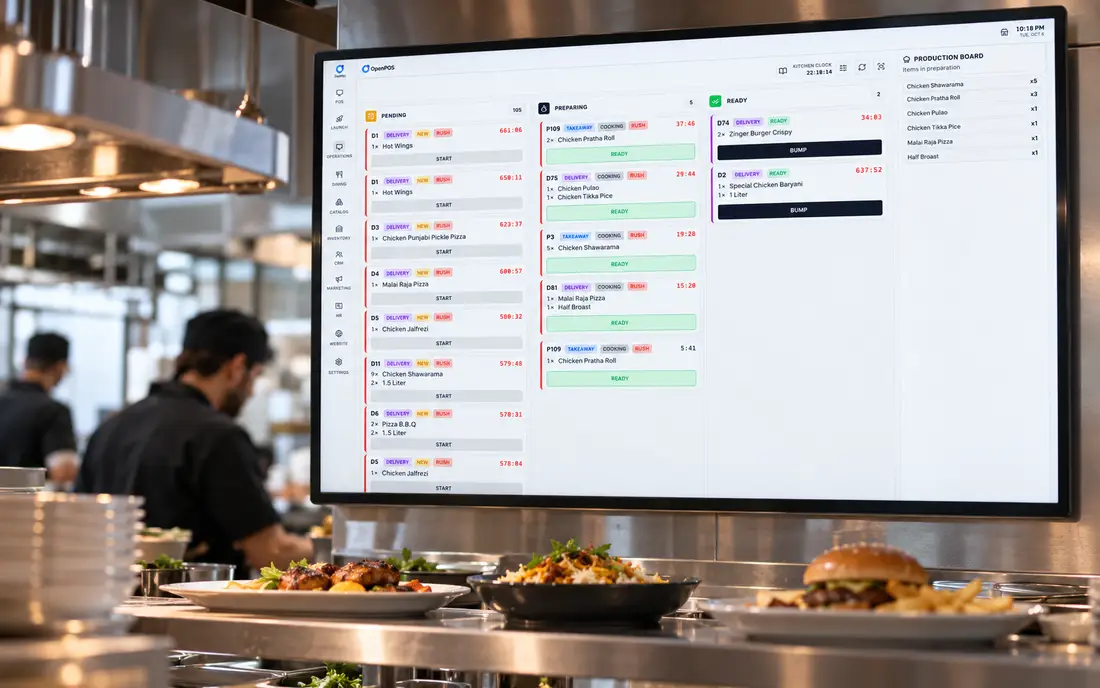
A cloud POS keeps the brain of the system on a remote server and treats your terminal as a window onto it. Most offer an "offline mode", but it usually caches a limited set of actions and then degrades once the connection is gone for long enough. SureTill inverts that. The full backend and local database run on a server inside your restaurant, and desktop and Android terminals connect to it over your local network. Billing, KOT routing, the kitchen display, and recipe inventory all run locally, so a dropped line during a Friday dinner rush changes nothing on the floor.
This is not a fallback mode bolted on for marketing; it is the core of the product. When connectivity returns, terminals reconcile through an event-sourced sync that does not overwrite or lose orders. You can read the full breakdown of how the offline-first architecture works, but the short version is that the restaurant keeps running whether or not the internet does. For an outlet in a market where power cuts and patchy links are routine, that reliability is often the whole reason to move.
Data ownership and self-hosting
With a purely cloud platform, your menu, sales history and customer records live on the vendor's infrastructure, and your access to them depends on your subscription staying active. SureTill keeps the source of truth inside your restaurant. Your data is exportable at any time, and the whole system can be self-hosted on your own hardware if you want zero external dependency. The cloud mirror exists for central reporting and off-site backup, but it is optional, switch it off and nothing on the floor breaks.
For a single café this may be a philosophical nicety. For a growing group with several outlets and years of history, owning your data outright is a genuine operational and negotiating advantage.
A built-in credit ledger, not a spreadsheet
Plenty of Indian restaurants still run a paper udhaar book or a side spreadsheet for regulars and corporate accounts. SureTill builds that in. Every credit customer gets a real account with a limit, a running balance, payments applied oldest-bill-first, and printed or PDF statements on demand, plus optional WhatsApp and SMS balance reminders. It is the same digital-khata thinking that replaces a register with something that reconciles itself. There is more on khata and customer credit if that is a big part of your business.
Pair that with a recipe-based inventory engine that deducts ingredients the moment an order hits the kitchen, and you have the two areas where small restaurants quietly lose money, unpaid credit and food-cost leakage, handled inside the same system that prints the bill.
SureTill prints itemised, GST-ready bills with configurable tax rates and your business details on customisable templates. Statutory e-invoicing rules differ by country and are revised over time. India's GST regime is distinct from Pakistan's FBR system, which does not apply in India, so confirm your specific filing requirements with your accountant before you go live.
Side by side
| What matters | Cloud-first POS | SureTill |
|---|---|---|
| Works with no internet | Limited offline mode | Full system, offline by design |
| GST bills & KOT | Yes | Yes, customisable templates |
| Built-in credit ledger (khata) | Varies / add-on | Built in |
| Data ownership | On vendor cloud | Yours, self-host option |
| Multi-branch dashboard | Yes | Yes, cloud mirror optional |
Read that table as a starting point for your own diligence, not a verdict. The right way to choose is to put both systems in front of your own staff, with your own menu, and, critically, to test each one with the internet physically disconnected. That single test tells you more than any feature list.
Book a thirty-minute demo and we'll run a live bill and KOT, then pull the internet cable and show you service continue. Bring your toughest questions.
Book a free demoFrequently asked
Is SureTill a good alternative to Petpooja?
If offline reliability and data ownership matter to you, yes, those are its core strengths. Petpooja remains a strong cloud platform with a large integration ecosystem, so the honest answer is to compare both against your own priorities and connection reality.
Does SureTill work without internet?
Completely. SureTill runs on a server inside your restaurant, so billing, KOT, the kitchen display and inventory continue offline, then reconcile on reconnect without losing orders.
Can it print GST bills and KOTs?
Yes, itemised bills with configurable tax rates on customisable templates, and KOT routing to stations or screens. Confirm your statutory e-invoicing requirements with your accountant.
Will I own my data?
Yes. It stays inside your restaurant, is exportable any time, and SureTill can be self-hosted on your own hardware. The cloud is a mirror, not a dependency.
Comparison is general information for restaurant owners, not an endorsement or criticism of any named product. Verify current features, pricing and tax-compliance details directly with each vendor and your own adviser before deciding.