
Home / Features / Inventory & recipes
Restaurant inventory that moves when the kitchen cooks
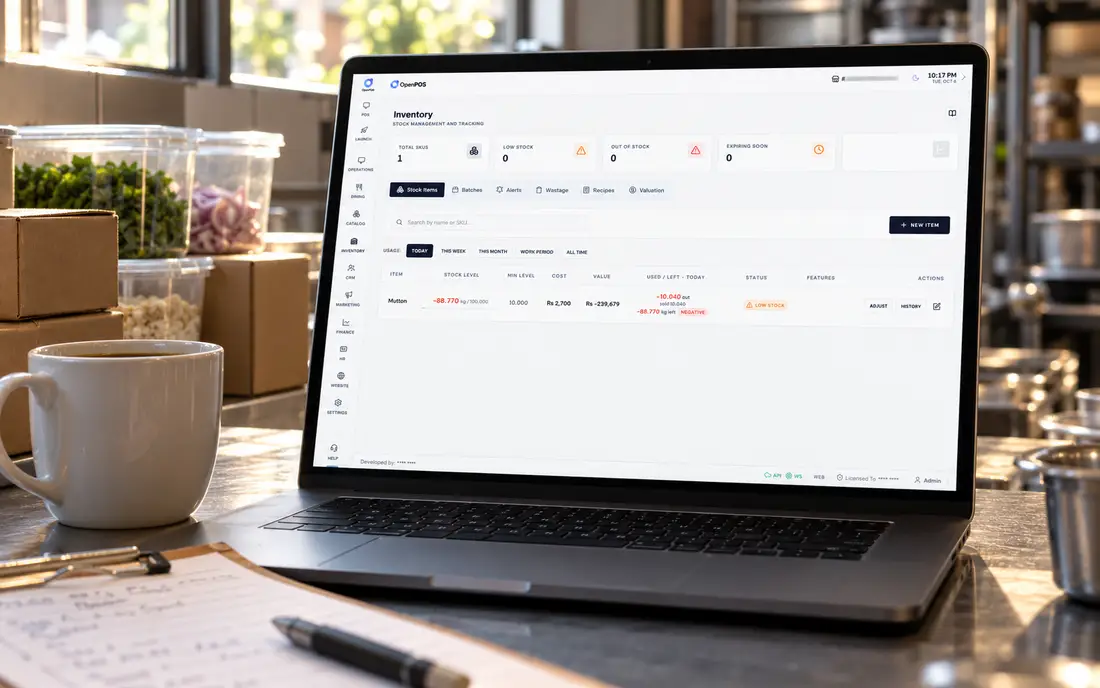
Restaurant inventory management software that ties every dish to its recipe, so every order deducts real ingredients in real units the moment it reaches the kitchen. At the end of the week you compare what should have been used against what actually was, and finally have a number to act on.
Where restaurant food cost actually leaks
Most kitchens with an "inventory problem" have a visibility problem: small, repeated losses that nobody writes down.
Over-portioning is the biggest, a few extra grams on every plate adds up to kilos a week. Then there is waste: trim, spoilage, dishes sent back, prep that outlives its shelf life. Add receiving errors, unrecorded staff meals and the occasional bit of shrinkage, and a kitchen can quietly run several points over where it should be. A monthly stock count gives you one number, once, long after the decisions that caused it. Recipe inventory tracks usage continuously against what your recipes say you should have used, so the leak shows up while you can still fix it.
"When exactly do you deduct stock, at kitchen-send, or at payment?" If the answer is payment, your inventory is wrong every time an order is fired but not yet settled, which on a busy night is most of them.
From order to stock movement, in one step
No end-of-day data entry, no separate stock clerk reconciling dockets at midnight. The deduction happens at the moment the order reaches the kitchen.
Two chicken burgers and a side of fries. The KOT prints and the KDS updates.
Each dish expands into its ingredients at the quantities you defined.
Grams of chicken, ml of oil, count of buns, in the units your store uses.
Theoretical vs counted, per shift. The gap is the conversation worth having.
Everything stock control actually needs
Built feature by feature against real service, recipes, wastage, expiry and food cost that keep restaurant inventory honest.
Buy flour in 20kg sacks, cook in grams. Define both units once and purchase entry stays as natural as recipe entry.
Spoilage, burnt dishes and comps are recorded with a reason and a name, and require a manager if you want them to.
Track perishables by batch with expiry dates, and get warned before something turns rather than after.
Set a threshold per ingredient. SureTill builds the purchase and requisition list, so the store manager stops working from memory.
A sauce base or a stock is itself a recipe. Prep once in the morning, and dishes deduct from the batch you made.
As purchase prices move, the cost and margin of every dish move with them, which is when menu pricing stops being a guess.
Deduct at kitchen-send, log every loss, compare to the count
Three design choices separate inventory software that tells the truth from inventory software that drifts.
Food is committed when the ticket reaches the kitchen, not when the guest pays. Deducting at that moment keeps stock true through the busiest part of service, open tabs, late payments and all.
Waste is logged against a reason. Batches flag what to use first. A void after cooking is either restocked or written off, never a silent hole you later blame on "shrinkage".
Recipe-perfect usage for the sales you made, against a physical count. The gap is your variance, and a growing gap on one ingredient tells you exactly which corner of the kitchen to walk into.
The variance report is the whole point
Before recipe tracking, our food cost was a number we calculated monthly and then argued about. Nobody could say whether a bad week was portioning, wastage, price rises or something walking out of the back door, so nothing changed.
Now the report says: this dish used more chicken than its recipe allows, on this shift. That is specific enough to act on the same day.
What the best restaurant inventory software should do
The best restaurant inventory software is the one wired into your POS, deducting at kitchen-send and still running when the internet doesn't. A separate stock app that someone updates at closing will always be a day behind the kitchen.
SureTill keeps inventory, billing, the kitchen display and reports in one system, so there is no export, no re-keying and no second login. Because every terminal is offline-first, stock keeps deducting through an outage and reconciles afterwards.
- Recipes and sub-recipes linked to every menu item
- Deduction at kitchen-send, not at payment
- Unit conversion between purchase and recipe units
- Wastage with reasons and optional manager approval
- Batch and expiry tracking for perishables
- Low-stock alerts and purchase lists
- Theoretical vs actual variance per ingredient
- Works offline, with each branch's stock visible from one multi-branch dashboard
Inventory questions
Something not covered? Ask on WhatsApp or email support@suretill.com, you'll get a straight answer, not a sales script.
What is recipe-based restaurant inventory software?
It links every menu item to its ingredients and quantities, so when a dish is ordered the software deducts those exact ingredients automatically. Your stock reflects what was actually cooked rather than a manual count taken once a month.
When does SureTill deduct ingredients from stock?
At kitchen-send, the moment the order reaches the kitchen, not when it is billed. That keeps stock accurate through service, and a voided item is restocked or logged as waste rather than silently disappearing.
Do I need a recipe for every item?
For ingredient-level tracking, yes, and we build them with you during setup rather than handing you a blank screen. Start with your highest-volume dishes; items without recipes still sell normally and simply don't move stock.
How does unit conversion work?
Define a purchase unit and a recipe unit per ingredient. Sacks in, grams out. Conversion happens automatically so neither the storekeeper nor the chef has to do arithmetic.
Can staff write off wastage themselves?
Only if you allow it. Wastage can require manager approval, and every entry records item, quantity, reason and the staff member in the audit log, visible in the shift report.
Does the inventory work offline and across branches?
Yes. SureTill runs on a server inside your restaurant, so deduction, waste logging and low-stock alerts continue with no internet. Across sites, each branch holds its own stock and recipes while one dashboard shows the group.
Bring one dish to the demo.
We'll build its recipe live, sell it, and show you the stock and cost move, on your own numbers.