
A cloud kitchen, also called a ghost kitchen or dark kitchen, cooks for delivery only, often running several online brands out of a single unit. It is a lean, high-volume model with a specific weakness: without a dining room, everything depends on software keeping the order flow, the menus and the stock straight. When that software stumbles, there is nowhere to hide.
What cloud kitchen software actually is
Cloud kitchen software is the operating system for a delivery-only kitchen. It pulls in orders from every channel you sell on, delivery aggregators, your own website, phone orders, normalises them into one queue, sends tickets to the kitchen, and tracks the inventory and cost behind each dish. Think of it as restaurant management software with the dining-room parts stripped out and the throughput parts turned up. The features that matter are order aggregation, per-brand menu control, a fast kitchen display, and inventory that keeps up automatically.
One kitchen, many brands
The defining trait of the cloud kitchen model is running multiple virtual brands from one physical space, a biryani brand, a burger brand and a dessert brand might all come off the same line. Your software has to treat each as a distinct brand with its own menu, pricing and receipt branding, while sharing one kitchen, one stockroom and one set of books underneath. Staff should work from a single screen, not a different tablet per brand and a mental map of which is which.
SureTill handles this the same way it handles multi-branch restaurants: each brand is configured independently, but reporting rolls up so you can see which brands actually make money and which just add noise. The full feature list covers how menus, modifiers and roles are structured.
Order routing and the kitchen display
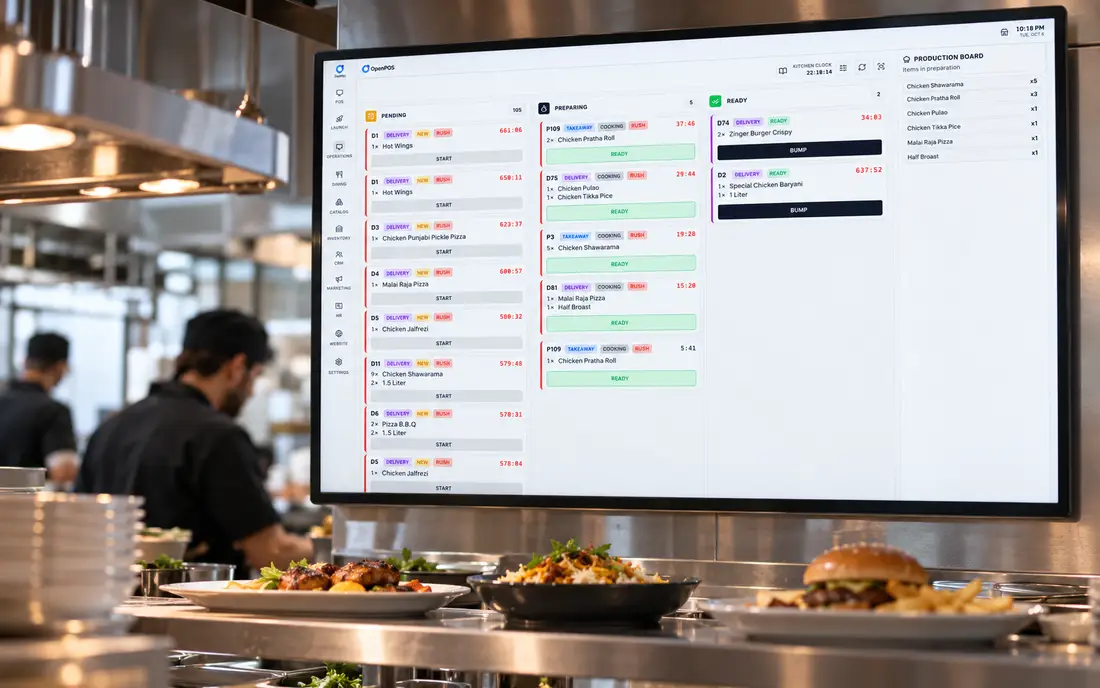
In a cloud kitchen the kitchen display system is not a nice-to-have, it is the whole floor. Every order, whichever brand and channel it came from, lands on the KDS as a ticket with its items, modifiers and timing. Per-station routing sends the right components to the right cook, fryer, grill, cold station, and colour-coded timers stop tickets ageing out. Bump a ticket when it's plated and the next one surfaces. Done well, this is what lets a small team run three brands without losing orders. There is a full kitchen display system guide if you want to go deeper on how a KDS is set up.
The practical test is aggregator load. When four tablets are all pinging at once during a dinner rush, does the system consolidate them into one calm queue, or does your expo end up manually re-keying orders? That re-keying is where mistakes and refunds come from.
Shared inventory and per-brand food cost
Because brands share a pantry, cloud kitchens are unusually exposed to inventory drift, one shared bag of chicken feeding three menus is hard to track by hand. Recipe-linked inventory solves this: SureTill deducts ingredients the moment an order is sent to the kitchen, no matter which brand rang it up, so a shared stockroom stays accurate in real time. You get per-brand food-cost visibility without stopping to count, plus wastage tracking, batches, expiry and low-stock alerts. If margins are thin, and in delivery they always are, the recipe inventory engine is the module that protects them.
SureTill prints itemised bills with configurable tax rates on customisable templates, which suits VAT, GST or sales-tax setups. Statutory e-invoicing rules differ by market and change over time. Pakistan's FBR system, for instance, applies only there, so confirm the requirements for your own country with a local adviser.
Why offline reliability still matters
"Cloud kitchen" describes the business model, not where your software has to live. Ironically, a delivery-only kitchen is more fragile to an internet outage than a dine-in restaurant, because there is no counter fallback, if the screens go dark, tickets simply stop. SureTill is offline-first: everything runs on a server inside your kitchen, so order entry, the KDS and inventory keep working through a dropped line and reconcile on reconnect. You can read how the offline architecture works, but the point for a cloud kitchen is simple, the line never goes blind.
How to choose
Judge cloud kitchen software on five things: how cleanly it aggregates orders from all your channels, whether it can run several brands from one screen without confusion, how sharp and responsive the kitchen display is under load, whether inventory keeps itself accurate across shared stock, and what happens when the internet drops. Insist on a live demo with real order volume and, as always, ask to see it run with the connection pulled.
Book a thirty-minute demo. We'll push orders across brands onto the KDS, deduct shared inventory live, then disconnect the internet and keep going.
Book a free demoFrequently asked
What is cloud kitchen software?
It runs a delivery-only kitchen, often several virtual brands from one location, handling per-brand menus, order aggregation, the kitchen display and shared inventory from a single system.
Can one POS run multiple virtual brands?
Yes. Each brand keeps its own menu, pricing and receipts while sharing one kitchen, one inventory pool and one set of reports, so staff work from one screen.
Does it work offline?
With SureTill, yes, everything runs on a server inside your kitchen, so order entry, the KDS and inventory keep running with no internet and reconcile on reconnect.
How does inventory work across brands?
Recipe-linked inventory deducts ingredients as each order is sent to the kitchen, whichever brand it came from, keeping a shared pantry accurate and per-brand food cost visible.
General guidance for operators. Tax and e-invoicing requirements vary by country and change over time, confirm your local obligations with a qualified adviser.