
If you are reading about Deliverect pricing or how Doshii works, you are probably tired of a counter covered in delivery tablets. Middleware is one fix. A POS that talks to the delivery app directly is another. They solve slightly different problems, and picking the wrong one means paying for a layer you do not use, or missing one you need.
Do you need Deliverect or Doshii?
You need delivery middleware when you sell on several delivery apps and your POS cannot talk to them directly. If most of your delivery orders come from Uber Eats and your POS integrates with Uber Eats directly, you may not need a middle layer at all.
Middleware such as Deliverect or Doshii earns its fee by connecting many apps to one POS. A direct integration does one connection without a middleman. Neither is better in general. The right answer depends on how many channels you sell on, and what your POS can already do.
What do Deliverect and Doshii actually do?
They sit between your POS and the ordering apps, collect orders from all of them, and pass them to your POS in one format. Most also help you manage menus across channels.
Deliverect is an international platform that aggregates orders from many delivery apps and online ordering channels into a restaurant's POS, with menu management and reporting across channels. It is typically charged as a subscription per location, with pricing depending on the plan and channels.
Doshii is an Australian integration platform that connects POS systems with ordering, delivery, payment and other hospitality apps. It is widely used in Australian venues, and the fees depend on which apps and POS are connected.
That is the neutral, widely known picture. Both change their products and plans, so check current pricing and supported apps on their sites before you budget.
What is a direct Uber Eats integration in the POS?
A direct integration means the POS itself connects to Uber Eats, with no service in between. The order goes from Uber Eats to the POS, and status updates go back the same way.
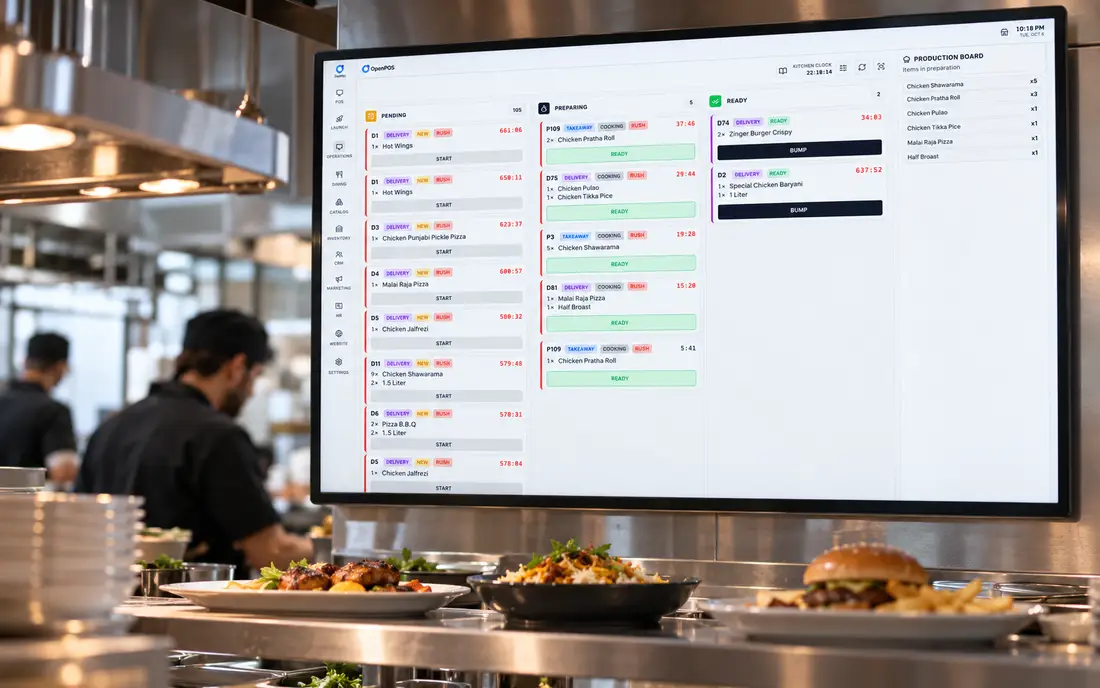
That is how SureTill works. SureTill integrates with Uber Eats through the official Uber Eats API, and any restaurant can connect its store. Uber Eats orders land in the same panel as dine-in and takeaway, print to the right kitchen station or show on the kitchen display, and are accepted, rejected and marked ready from SureTill. The Uber Eats menu and prices are managed from SureTill too, so there is no separate Uber Eats tablet to watch and no second menu to keep in step.
For other delivery apps such as DoorDash, delivery orders can also be brought into the kitchen. Ask us which delivery apps we can connect for your store.
How do middleware and a direct integration compare?
Compare them on the number of channels, cost, the number of moving parts and who you call when something breaks.
| Question | Delivery middleware (Deliverect, Doshii) | Direct integration in the POS |
|---|---|---|
| Number of apps covered | Many apps through one connection | Only the apps the POS connects to directly |
| Extra subscription | Yes, a fee for the middleware on top of your POS | No separate middleware fee |
| Moving parts | Delivery app, middleware, POS | Delivery app, POS |
| Menu management | Often managed in the middleware across channels | Managed in the POS for the connected apps |
| When something breaks | Three parties to check | Two parties to check |
| Best for | Venues on several apps, virtual brands, or POS without direct links | Venues where one or two apps carry most delivery orders |
The table is general. Some middleware plans are excellent value for multi-brand kitchens, and some direct integrations are thin. Ask for a live test order either way.
When is delivery middleware worth the fee?
Middleware earns its fee when the number of channels is the problem you are solving.
- You sell on three or more delivery apps and each brings meaningful volume.
- You run several virtual brands out of one kitchen and need menus and orders managed per brand across apps.
- Your POS has no direct integration with the apps you need, and switching POS is not on the table.
- You want one reporting view across every channel and your POS cannot provide it.
If two or more of those are true, middleware is probably the simpler path. It is a real product solving a real problem.
When is a direct integration enough?
A direct integration is enough when one app carries most of your delivery volume and your POS connects to it properly.
For many Australian takeaways and restaurants, that app is Uber Eats. If your POS takes Uber Eats orders directly, prints them to the kitchen, lets you accept and mark ready, and manages the menu and prices, the middle layer is doing very little for you. Removing it means one fewer subscription, one fewer login and one fewer place an order can get stuck.
This is also the cheapest change to test. Run Uber Eats directly through the POS for a few weeks and see whether you miss anything the middleware gave you. If you do, you know exactly what you are paying for.
What should you ask before choosing?
Ask the same questions of any middleware provider and any POS vendor, and get the answers in writing.
- Which delivery apps are supported today in Australia, and which are "coming soon"?
- What is the total monthly cost per location, including any per-order or per-channel fees?
- Does the order print to the right kitchen station automatically, with modifiers and notes?
- Can staff accept, reject and mark ready without touching the delivery app's tablet?
- Where is the menu edited, and how do price changes reach each app?
- What happens to orders if the internet drops, and who do you call when one goes missing?
Delivery apps send orders over the internet, so new orders need a connection whichever route you choose. With SureTill, orders already received stay on the kitchen tickets, and billing, the KDS and stock keep running offline.
Book a free 30-minute demo. We will unplug the internet mid-order and keep going. Bring your hardest questions.
Book a free demoFrequently asked
What does Deliverect do?
Deliverect is a platform that connects delivery apps and online ordering channels to a restaurant's POS, so orders from many apps arrive in one place. It also offers menu management and reporting across channels, usually for a subscription per location. Check current pricing on its site.
What is Doshii?
Doshii is an Australian integration platform that connects POS systems with ordering, delivery, payment and other hospitality apps. Fees depend on which apps and POS are connected, so check its site for current details.
Do I need Deliverect if my POS integrates with Uber Eats?
Not necessarily. If most of your delivery orders come from Uber Eats and your POS integrates with it directly, middleware may add cost without adding much. Middleware earns its fee when you sell on several apps or run virtual brands.
Does SureTill need Deliverect or Doshii for Uber Eats?
No. SureTill integrates with Uber Eats directly through the official Uber Eats API. Orders land in SureTill, print to the kitchen, and are accepted, rejected and marked ready from the POS.
Can SureTill take DoorDash orders?
DoorDash delivery orders can also be brought into the kitchen. Ask us on WhatsApp which delivery apps we can connect for your store.
Descriptions of Deliverect and Doshii are general and based on publicly available information; check their current products and pricing directly. Uber Eats is a trademark of Uber Technologies, Inc. SureTill is an independent integration and is not affiliated with or endorsed by Uber, Deliverect or Doshii.